Hug Shack: A Font Duo That Feels Like a Warm, Thoughtful Design Choice
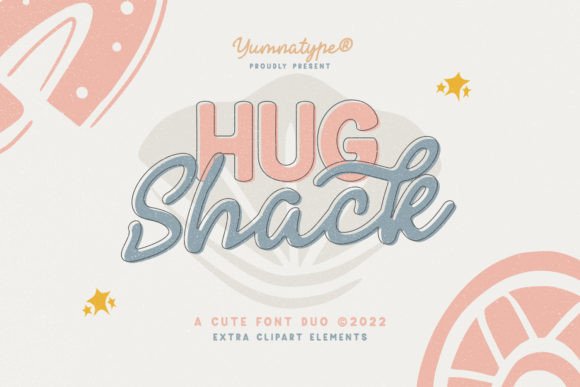
Imagine opening a design file and instantly feeling like you’ve found the right voice—not just for your headline, but for the whole mood of your project. That’s what happens with Hug Shack. It’s not one font—it’s a thoughtfully paired duo: a playful, rounded sans-serif for body or subhead text, and a charming, slightly bouncy script that adds personality without sacrificing readability. Together, they don’t just look good—they feel intentional, joyful, and human.
People reach for Hug Shack when they want their work to reflect warmth and approachability—not as an afterthought, but as a core part of the message. Think of it like choosing the right tone in a conversation: friendly but not overbearing, polished but never stiff. Whether you’re designing a birthday invitation for a niece, a product label for your small-batch candle line, or a slide deck for a parent-teacher workshop, Hug Shack helps your visuals land with sincerity.
Where Hug Shack Fits Naturally—Not Just Where It Looks Cute
It’s easy to assume a font this cheerful only belongs on greeting cards or kids’ party printables. But real-world use tells a different story. Small business owners use Hug Shack for packaging labels because its rounded forms soften the visual weight of ingredient lists or care instructions—making practical details feel less clinical and more personal. A local bakery might pair the script for “Honey Oat Loaf” with the sans for “Baked daily • 100% organic flour,” giving both flavor and function equal presence.
Educators and homeschoolers choose Hug Shack for classroom posters and learning mats—not because it’s “cute,” but because its open letterforms and consistent spacing support early readers. The lowercase “a” and “g” are clear and unambiguous; the swashes (more on those in a moment) appear only where intentionally activated, so there’s no confusion during decoding practice. One third-grade teacher told us she uses the sans version for vocabulary flashcards and switches to the script only for title headers—creating visual hierarchy that students internalize without being taught.
Bloggers and content creators apply Hug Shack selectively in digital spaces: as a custom heading font in Canva templates, embedded in email newsletters via image-based headers, or as SVG text in landing pages where web-safe fallbacks would flatten the tone. It works especially well for lifestyle niches—mindfulness coaches, craft instructors, or wellness practitioners—whose audiences respond to authenticity over polish. You wouldn’t use it for a legal disclaimer, but you *would* use it for a “Welcome Back” banner in your online course dashboard.
Why the PUA Encoding Matters More Than You Might Think
Hug Shack is PUA encoded—a technical detail that quietly solves real problems. PUA stands for Private Use Area, and it means every alternate glyph, ligature, and swash lives in a predictable, accessible location in the font file. No digging through obscure font menus. No guessing whether “Q” + “Shift” + “Option” will trigger the curly tail on the script “y.”
This makes a difference when time is tight. A freelance designer building five social media banners before lunch doesn’t need to hunt for stylistic sets across three panels in Adobe Illustrator. With Hug Shack, they type normally—and then click once to swap in a flourished “&” or a dotted “i” from the Glyphs panel. Same goes for educators copying and pasting into Google Slides: paste the text, open the font menu, and select the swash variant directly—no extra plugins or workarounds.
Realistic Things to Keep in Mind Before You Use It
Hug Shack shines brightest when contrast and intention guide its use—not volume. Because both fonts carry expressive weight, stacking them without breathing room can overwhelm. Try this rule of thumb: if you’re using the script for more than two words in a row, pause and ask whether the sans version (or even a neutral serif) might serve clarity better. One food blogger learned this the hard way when her recipe card’s “Prep • Cook • Rest” icons—set entirely in the script—got misread as decorative blobs by mobile users scrolling quickly.
Also consider context. While Hug Shack renders beautifully on screen at 24px and up, smaller UI elements (like button labels or form placeholders) often benefit from the sans alone—or a simpler fallback. Its charm comes from rhythm and space, not density. And if you’re licensing it for client work, double-check the license terms: most versions allow commercial use, but embedding in apps or SaaS platforms may require an extended license.
Who Gets the Most Out of Hug Shack—And Why
- Freelancers appreciate how fast it is to build brand-consistent assets—logos, pitch decks, proposal covers—that convey care without requiring custom illustration.
- Small shop owners find it bridges the gap between handmade charm and professional presentation, especially on Instagram posts where first impressions happen in under two seconds.
- Hobbyists and makers love that it scales gracefully—from hand-lettered-style printable planners to laser-cut wood signs—because the outlines stay clean at any size.
- Nonprofits and community groups use it to soften formal messaging: a food bank’s “Grab & Go Lunch” sign feels welcoming, not transactional; a library’s summer reading challenge poster invites participation instead of demanding attention.
What ties these uses together isn’t just aesthetics—it’s emotional utility. Hug Shack doesn’t shout. It leans in. It gives designers permission to prioritize warmth without sacrificing structure, and it gives audiences permission to relax into the message. That’s rare. And it’s why, months after downloading, people still reach for Hug Shack—not as a trend, but as a trusted tool.
If you’ve ever spent too long searching for a font that feels like “you,” or hesitated before sending a design because it looked technically correct but emotionally flat—Hug Shack is worth trying. Not as a gimmick, but as a quiet, consistent way to make your work feel more like a conversation and less like a broadcast.